Agadir’s Must-See Historic Site
At 236 meters above Agadir, the Agadir Oufella Kasbah is THE unmissable historic site in the city. This ancient 16th-century fortified citadel offers not only the best panoramic view of Agadir Bay, but also tells a fascinating story of Saadian conquests, international trade, and modern tragedy. In this complete guide to visiting the Agadir Kasbah, discover its captivating history, well-kept secrets, and all our practical tips for a successful visit in 2025.
Thank you for reading this post, don't forget to subscribe!Because between us, there are things you need to know before heading up there!
The Extraordinary History of the Agadir oufella Kasbah
Strategic Origins in the 16th Century
The history of the Agadir Kasbah begins in the 16th century, in a not-so-peaceful context. In 1470, the Portuguese settled at the foot of the hill and founded Santa Cruz do Cabo de Gué. Imagine that: a Portuguese colony on the Moroccan coast! Obviously, that couldn’t last.
In 1540, the Saadian Sultan Mohammed Ech-Sheikh decided to handle the problem his own way. He had a fort built at the top of the hill. The choice wasn’t random at all – from this dominant position, it was impossible for the Portuguese to hold their positions below. A topographical superiority that ensured Moroccan sovereignty over this crucial stretch of Atlantic coastline.
Visiting the Agadir Kasbah today allows you to discover this unique heritage and understand these historic strategic stakes.
Transformation into a Thriving Trading City
Under Abdellah El Ghalib, the small military fort completely changed face. It transformed into a true urban citadel encompassing the entire hill. What’s striking is that the Agadir Oufella Kasbah wasn’t just an austere fortress: it actually housed a complete city with:
Winding alleyways, homes for several thousand inhabitants, bustling markets, a grand mosque, a hospital, Makhzen government offices, and even a Jewish quarter (Mellah). A real little perched city!
An Unsuspected International Trading Hub
For several centuries, the Agadir Kasbah functioned as a major commercial hub connecting three continents. Its exceptional geographical position made it the perfect meeting point between Saharan caravan routes and maritime routes to Europe, Asia, and even America.
The cosmopolitan side of the citadel can still be seen today: French, English, Danish, Portuguese, Spanish, and especially Dutch merchants traded there. By the way, a detail many miss: the Kasbah entrance gate still bears a bilingual Arabic-Dutch inscription that reads “Fear God and Respect the King”. This inscription carved in stone testifies to the importance of trade relations between Morocco and the Netherlands at that time. Pretty surprising, right?
The 1960 Earthquake: The Tragedy That Changed Everything
A Devastating Catastrophe
February 29, 1960 – a date etched in everyone’s memory. At 11:40 PM, a magnitude 5.7 earthquake struck the Agadir region. The epicenter? Exactly under the Kasbah hill.
In just seconds, the historic citadel and surrounding neighborhoods – Kasbah, Ihchach, Talborjt, and Founty – were practically wiped off the map. The human toll remains terrifying: more than a third of the population perished under the rubble. This tragic night destroyed centuries of history and forever transformed Agadir’s face.
Rebirth: A New City to the South
Faced with this devastation, His Majesty the late King Mohammed V made a historic decision the very next day. He entrusted reconstruction supervision to a commission led by Crown Prince Moulay Hassan (the future Hassan II). The most important urban planning decision was radical: Agadir would be rebuilt further south, away from the seismic epicenter.
That’s why modern Agadir has this new city appearance, with its wide avenues, earthquake-resistant buildings, and contemporary urban plan. The old Agadir Kasbah, meanwhile, remained in ruins on its hill, transformed into a memorial site and silent witness to a bygone past.
The Kasbah Today: Renaissance and Enhancement
An Ambitious Rehabilitation Project
Far from being abandoned, the Agadir Oufella Kasbah is experiencing a true renaissance today thanks to an extensive rehabilitation project. Authorities have employed modern techniques specific to traditional building archaeology to restore the remains while respecting their historical integrity.
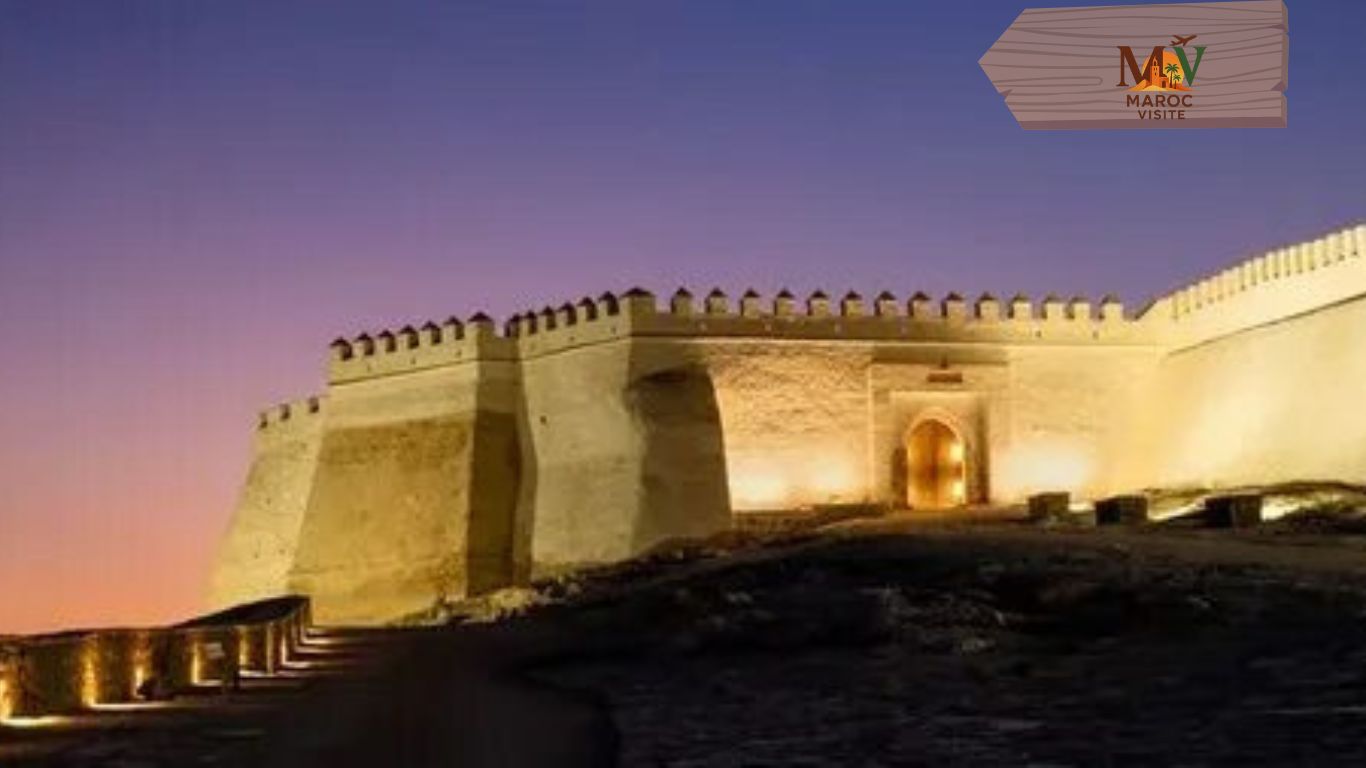
Today, when you visit the Agadir oufella Kasbah, you can walk through the authentic 16th-century entrance gate, walk along the reconstructed ramparts, observe the remains of the ancient medina, and discover the foundations of historic buildings. It’s really impressive to see how they’ve managed to bring this place back to life.
Exceptional Panoramic View of the Bay
Beyond its obvious historical interest, the Agadir Kasbah offers the best panoramic view of Agadir, that’s indisputable. From its ramparts, you can take in Agadir Bay in all its splendor, the modern marina with its pleasure port, the commercial port, that beach stretching for kilometers, and the entire new city.
It’s actually the best viewpoint in Agadir for photographing the bay – influencers and photographers know it well!
The spectacle is particularly magical at sunset – when golden light sets the bay ablaze and the city gradually lights up. Honestly, it’s one of the most beautiful sunsets in Morocco.
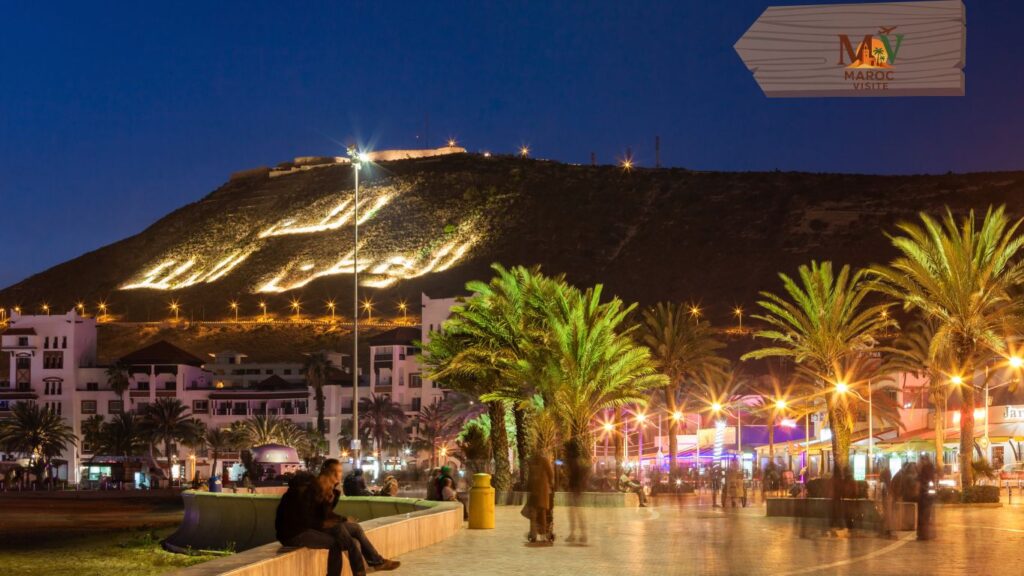
On the south side of the hill, you can’t miss the monumental inscription “God, Country, King” (Allah, Al Watan, Al Malik in Arabic), visible from the entire bay. It really reinforces the national symbolic significance of the place.
Practical Guide: How to Visit the Agadir Oufella Kasbah
Three Modern Access Options
Accessibility to the Agadir Kasbah has considerably improved in recent years, fortunately:
1. The Agadir Cable Car (we really recommend it) 1.7 km journey in just 6 minutes, with spectacular views throughout the ride. It’s modern, comfortable, and avoids the climb that can be tiring. The cable car has become an attraction in itself for visiting the Kasbah!
2. Paved Road Direct motorized access to the summit – you can go by taxi or your own car. The road itself is scenic with several nice viewpoints.
3. Regular Shuttles Departures every 20 minutes from the foot of the hill. Economical solution with regular service all day.
Hours and Rates to Visit the Agadir Kasbah
Opening hours: Every day from 9:00 AM to 6:00 PM Best time: Late afternoon to enjoy the sunset Visit duration: Plan 1.5 to 2 hours for a complete visit, without rushing
Book your guided Kasbah tour on GetYourGuide and benefit from detailed explanations by a professional local guide. Honestly, it’s worth it to understand all the historical details.
Our Tips for a Successful Visit
Go for late afternoon to avoid the heat and enjoy the sunset. Wear comfortable shoes for walking on the remains – some parts can be a bit slippery. Don’t forget to bring water and sun protection (hat, sunscreen) because there isn’t much shade up there.
Bring your camera to capture the panorama from the Agadir Oufella Kasbah, you’ll take dozens! And plan about 2 hours for a leisurely visit, so you’re not rushed.
For an even more complete experience, discover our one-day Agadir itinerary.
What to See and Do Around the Kasbah
Visiting the Agadir Kasbah easily combines with other Agadir attractions:
Agadir Marina
Just minutes away, Agadir Marina offers a modern, lively atmosphere with its restaurants, shops, and pleasure port. It’s the ideal place for lunch after your Kasbah visit – the contrast between old and new is striking. Check out our Agadir Marina guide.
Souk El Had
For a real immersion in Moroccan authenticity, don’t miss Souk El Had – one of Morocco’s largest markets. Spices, crafts, fruits and vegetables in a colorful, lively atmosphere. It’s completely different from the Kasbah’s tranquility!
Agadir Beach
With its 10 kilometers of fine sand, Agadir Beach is perfect for relaxing after cultural visits. Discover all the water activities available in our Agadir beaches guide.
Book a combined Kasbah + Souk + Marina excursion on GetYourGuide to optimize your time and not miss anything.
The Kasbah’s Cultural and Memorial Importance
The Agadir Oufella Kasbah is much more than a simple tourist attraction. It embodies three major symbolic dimensions that overlap:
1. Historic Witness
It represents Agadir’s historic soul, testifying to several centuries of international trade and cosmopolitan life well before the modern era. It’s fascinating to think that this hill was already a global crossroads when Europe was barely discovering America.
2. Earthquake Memorial
It honors the memory of the 1960 earthquake victims and symbolizes the Moroccan people’s resilience in the face of tragedy. This memorial dimension gives particular depth to the visit.
3. Symbol of Rebirth
Its contemporary rehabilitation illustrates Agadir’s ability to preserve its heritage while turning toward the future with modern technologies like the cable car. A beautiful example of respectful modernization.
Why Visiting the Agadir Oufella Kasbah is Essential
Visiting the Agadir Oufella Kasbah is much more than admiring an exceptional panorama (even though it’s truly spectacular). It’s diving into five centuries of Moroccan history, understanding the geopolitical stakes of Saadian Morocco, paying tribute to victims of a national tragedy, discovering a site in full heritage renaissance, and capturing the most beautiful photos of your Agadir stay.
For history and Moroccan culture enthusiasts, this visit proves absolutely essential. For others, it’s a memorable experience combining natural beauty, historical emotion, and technological modernity. A mix you won’t find everywhere.
Visiting Agadir without going up to the Kasbah really means missing the essence of this historic city.
Explore all available activities in Agadir on GetYourGuide and plan your ideal stay.
Conclusion: A Journey Through Time in the Heart of Agadir
The Agadir Oufella Kasbah is much more than a geographical high point: it’s the historic and spiritual heart of a city that knew how to rise from its ashes. From military fortress to cosmopolitan commercial crossroads, from place of tragedy to memorial site, it has crossed centuries and trials while preserving its evocative power intact.
Today restored and accessible thanks to modern infrastructure, the Kasbah offers all visitors this unique opportunity to travel through time while enjoying a breathtaking panorama. Whether you’re a history enthusiast, photography lover, or simply curious, this visit will mark your Agadir stay with an indelible imprint.
Don’t wait any longer and put the Agadir Kasbah at the top of your list for your next trip to southern Morocco. These ancient stones still have so many stories to whisper, you just need to know how to listen…
Plan your visit now and discover all our other guides on MarocVisit.com for an unforgettable stay in Morocco.